
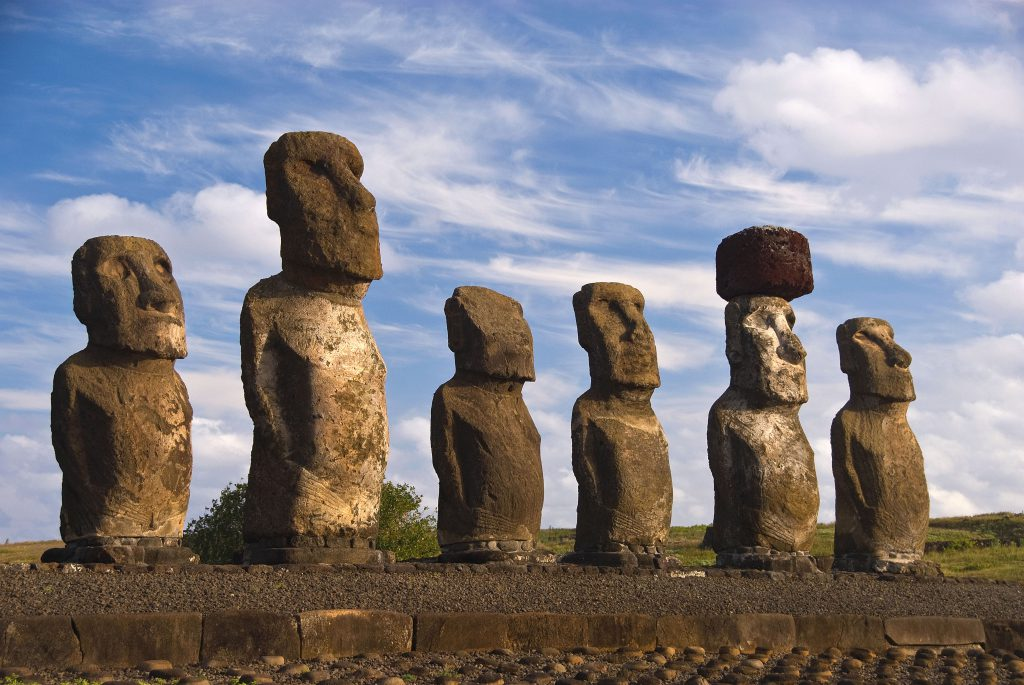
On a solitary volcanic isle in the southeastern Pacific, about 2,000 miles from the nearest continent, the Moai are found—significant stone figures sculptured between the thirteenth and the sixteenth century. Rising from the grassy slopes of Rapa Nui (Easter Island) these statues have long filled historians, archaeologists, and architects with wonder. But beyond their colossal presence, the Moai imply something profound—a philosophy of design rooted in community, balance, and reverence to posterity.
Carving the Ancestors
The Rapa Nui people produced the Moai as a tribute to their ancestors and their leaders, incarnate as living spirits watching over the island. Most of them were from 13 to 33 feet high, while the largest, an unfinished Moai at the Rano Raraku quarry, would have attained a height of more than 70 feet and a weight of more than 270 tons.
Carved from volcanic tuff with basalt tools, each statue has a long, elongated head, deep eye pits, and prominent eyebrows, which symbolize authority and wisdom. Most of them were originally surmounted by a red scoria “hat” or pukao, symbolizing a distinctive brand of royal and noble-mindedness.
But perhaps the most interesting feature is what is not seen. The Moai were not merely heads. Excavations have disclosed that what would not have been seen by the ordinary observer often exists beneath the surface: a body with engravings and petroglyphs that probably refer to genealogy, sea-faring, or cosmography. Man-Less Engineering / Motion
Rapa Nui’s methods for transporting these massive statues across the Islands fueled debate for hundreds of years. It was once believed that these statues were rolled along tree trunks, where ideas about human destruction, the abuse of land, and its eventual disintegration were spawned. New data has changed that finding to a complete rational explanation posited by investigators.
Group representatives like Carl Lipo and Terry Hunt announced as recently as 40 years ago that small groups could have “walked” the stones into their upright position by using ropes and a slow, forward motion. This plan is based on oral traditional evidence and indicates that technology should have been attributable to the institutions rather than the land they engaged in.
It deploys the Moai from an obstacle to an ecological calamity to prove that it examined and pointed out the extremes of engineering through original reasoning that existed long before the modern movement.
Community and Cosmic Order
All Moai were formerly positioned on stone platforms called Ahu, facing towards the land masses, thus indicating that they served as a form of protection for the various villages or homes, and that deposits of mineral man were a form of communication from ancestors to the living.
The construction of Ahus and Moai was a communal exercise that resulted not only in the clay reproduction of residence structures and worship, but also in the formation of a group identity. Villages collaborated and worked together to quarry stone, transport it, and erect and construct their Moai, thereby engaging in group participation, creating social bonds and meanings for existence through religion.
Just as it was before the setting of rational reasoning among captive clans against each other, the culture had to march backwards through the trenches, and it was during this time that, while each clan engaged in toppling the other’s Moai, this was more than mere lust for destruction. It involved the principles of wily warfare, both utilized and fabricated; therefore, it didn’t indicate more than an appearance that the Moai had once been cultural, given the tones of permanence.
The Moai Today
Nearly 900 Moai are present on Rapa Nui, where many have been restored after hundreds of years of climatic erosion and indifferent colonial care. In 1995, the United Nations agreed that the Islands were of cultural and archaeological importance compared to other land areas of similar dimensions.
Thus, the Islands were declared a World Heritage Site. The preservation today continues to challenge groups. The gradual rise in tides, along with increased tourist traffic, exposes the Ahu and Moai created with great care. Concurrently, the local residents, legally known as Rapa Nui, are laboring with the ideological problem of acquiring greater cultural autonomy, especially those presently held in other foreign museums, such as the British Museum in London, which serves as their foremost adopted home.
The Moai are not relics or remains of an obsolete civilization, nor are they part of a continuum possessing any historic link with each other; the socio-cultural aspects of exhibitivity are a critical remainder that is manifested and existent. The Moai, becoming therefore more than pure relics of lost civilization, are themselves each part of a living tradition, of past, present, and future.
Why They Last
The Moai are still lasting. More than mere storage, they imply a world of thought existing and material existence. This concept dwarfs the construction of religion, building, and community existence, and is identical to its own existence. Their stony appraisals herein contradict the idea that architecture is to erect possible means of stateliness, but there exist incubators and a spirit of survival. In Rapa Nui life, two worlds collide; therefore, each Moai is the completion of closure between generations, a stone manifesto of belonging, identity itself, and the spirit of existence against isolation.
Sources
- UNESCO World Heritage Centre. “Rapa Nui National Park.” (1995–present).
- Hunt, Terry L., and Carl P. Lipo. The Statues That Walked: Unraveling the Mystery of Easter Island. Free Press, 2011.
- Van Tilburg, Jo Anne. Among Stone Giants: The Life of Katherine Routledge and Her Remarkable Expedition to Easter Island. Scribner, 2003.
- Smithsonian Magazine. “Easter Island’s Mysterious Moai Statues.” April 2022.
- National Geographic. “How Easter Island’s Giant Stone Statues Were ‘Walked’ Into Place.” 2013.