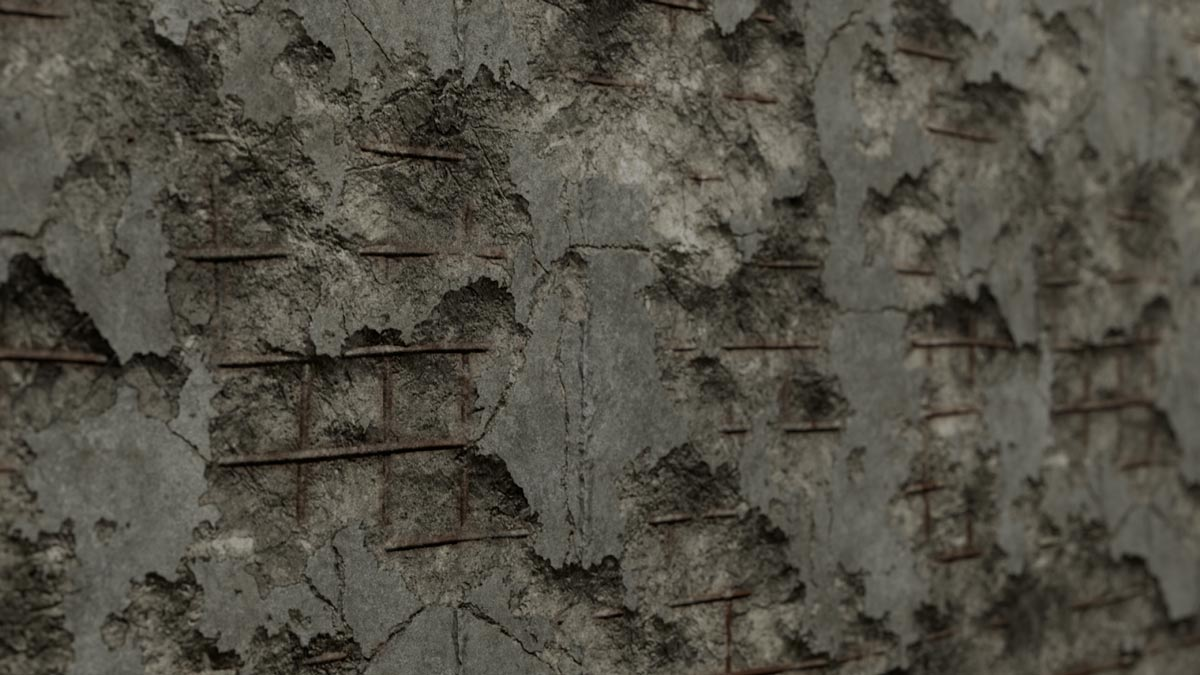

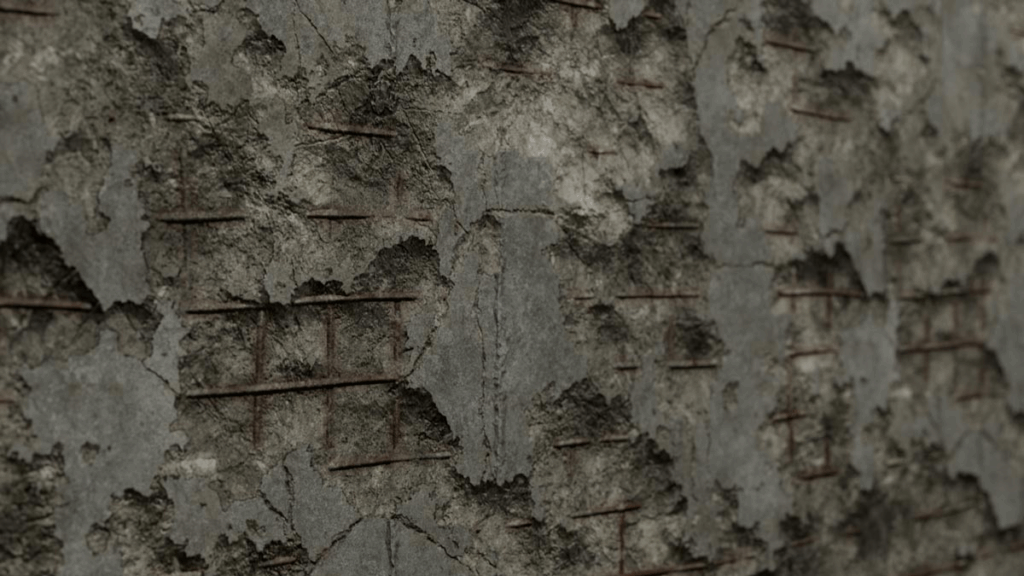
In between the cracks of worn-overpasses and the peeling facades of postwar housing blocks, a strange beauty reveals itself, one about which architects seldom talk, but which conservationists study increasingly: concrete spalling. Spalling—the breakdown and exfoliation of concrete’s surface, once regarded as a sign of failure—has become a window into the hidden life cycle of modern architecture.
Concrete, a 20th-century material, was once synonymous with permanence. Still, its iron reinforcement, during manufacture, begins, within a few years, to rust, expand, and rupture its surrounding matrix. The U.N.H.P. (Unité d’Habitation) of Le Corbusier in Marseilles shows, for example, micro-fissures in the concrete that expose the skeleton of reinforcement bars and give voice to the tension between the modernist’s idea of immortality and the inevitability of decay. This decay tells a material story of time, climate, and industrial chemistry.
Researchers in ancient Roman construction from TU Delft and ETH Zurich have documented how, especially in coastal cities, chloride salt infiltration increases corrosion of reinforced concrete. In Dr. Andrea Frangi’s 2022 report, the porosity and carbonation of mid-century concrete were shown to differ radically depending on the manufacturer, so two buildings completed in the same year might age in totally different ways. It is in this way of material biography that each fissure and rust spot implies the politics and economy of its mode of manufacture.
In the realm of preservation theory, the arguments of such scholars as Dr. Caitlin DeSilvey (University of Exeter) point out the necessity of construing the modern ruin not as failure but as “curated decay,” since allowing concrete to age naturally provides a genetic relation from place to place politically and time-wise, a continuance both of ecology and of history — a reminder that architecture, like the societies it houses, is mortal.
This is remembering to be forgotten ecologically. The effect of this precept, without going into greater depth, is to arm modern conservationists with weapons for the curbing of climate change on the continent of Europe.
In Europe, one hears, the conservational process is now getting underway. Berlin’s Mäusebunker, the radical block of the very biosphere, the brutalist biomedical research laboratory set for demolition, is now to have its corroded exterior stabilized, if not restored. The object is not to obliterate the past but to let entropy provide material evidence of the cause of the amelioration of technological optimism against clear limits, both genetically and personally performed.
This dialogue provides a philosophical turn to architecture, moving from control to acceptance. The 20th century was the century that conquered nature in architecture; the alteration of it to 21st-century principles may exist in architecture as co-author with time itself, rust, water, and climate. Concrete, once the emblem of modern durability, becomes the complexity of slow revelation.
In every particle of falling plaster from the spalling of the beam itself, there lies a lesson and a warning: for endurance in architecture or life is not the absence of decay, but the ease with which a faint smile may accompany its removal.
Sources:
- Frangi, Andrea. Material Aging and Chloride Penetration in Reinforced Concrete, ETH Zurich, 2022.
- DeSilvey, Caitlin. Curated Decay: Heritage Beyond Saving. University of Minnesota Press, 2017.
- TU Delft Concrete Laboratory. Chloride Transport and Carbonation in Postwar Concrete, 2021.
- Heritage Futures Project, University of Exeter, 2020.