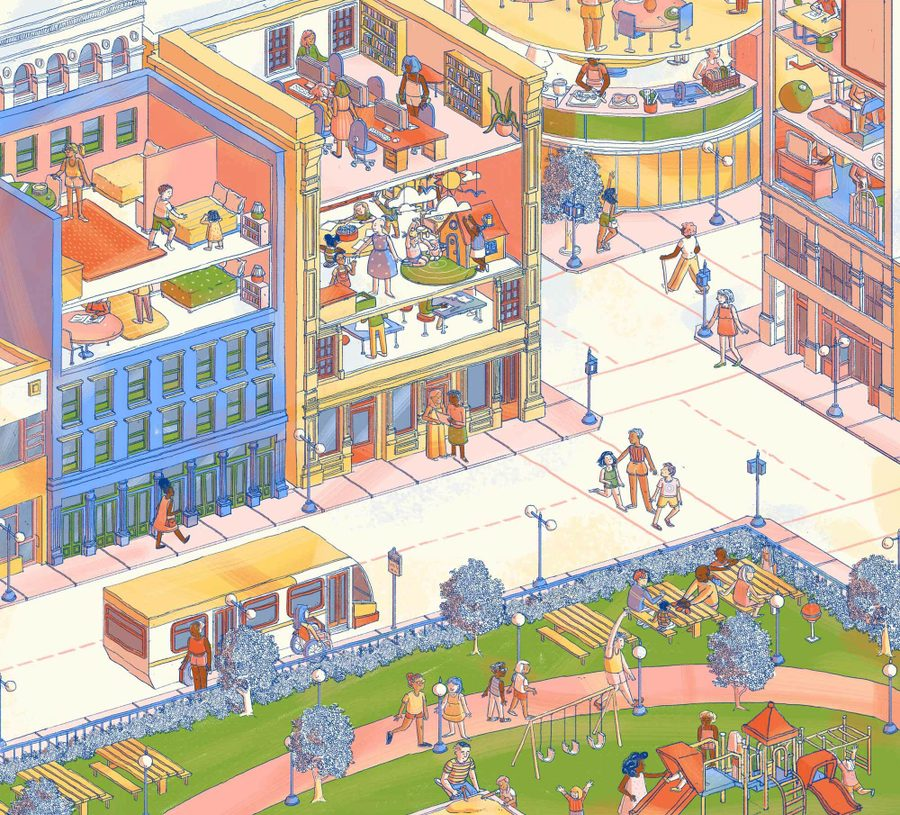

Architecture is often perceived as neutral —a series of walls, streets, and rooms that simply happen to be there. Nevertheless, for centuries, the built environment has quietly endorsed the divisions of gender, class, and power. Decisions made in the design of street naming, public lavatories, city parks, etc., have produced movement, groupings, and feelings of security or insecurity in the use of surrounding space. The subject of gendered space impels us to look more closely at these invisible structures and to ask who the architecture serves.
The Origins of Spatial Inequities

The ideas of gendered space are found in late nineteenth-century urban planning. The cities of London and Paris during the Industrial Revolution were physically arranged on the topography of a rigid concept of the public-private dichotomy. The men went to the factories, the offices, and the public life of the city; women were constrained to the domestic interiors. Dolores Hayden has written in The Grand Domestic Revolution that the house became a spatial expression of women’s economic dependence, designed to conscript unpaid labor into isolation but to glory in domestic virtue.
Even when women entered the labor force, the city itself continued to epitomize masculine values—speed, efficiency, surveillance, and scale—while ignoring, on the one hand, social housework and the conditions of accessibility and safety. This is no abstraction. It is manifested in everything from inadequately lit subway stations to the total absence of day nurseries in office towers.
The City as a Gendered Landscape
Urban sociologist Leslie Kern, author of Feminist City, argues that cities have long been designed for a “universal” citizen who doesn’t exist—usually imagined as male, able-bodied, and unencumbered by dependents. Sidewalk widths, transit schedules, and zoning laws all subtly reflect that assumption.
In Kern’s research on Toronto and London, she found that women often alter the routes they take, their daily routines, and their clothing choices because of perceived safety. These sorts of micro-alterations are architectural, not personal changes. This is to say that fear is designed into the environment.
At the same time, those who are gender non-conforming face an added layer of exclusion through architectural norms that enforce binary spaces—especially restrooms, locker rooms, and housing. Activist and designer Joel Sanders, through the Stalled! An initiative at Yale University has proposed inclusive restroom prototypes that prioritize privacy, safety, and dignity for all users. Their designs challenge the idea that segregation of the sexes is a natural or efficient spatial logic.
Public Space Through Care
A new generation of architects and planners is re-imagining cities on principles that incorporate care and inclusion. In Vienna, the city’s gender mainstreaming initiative—started in 1991—has led to redesigned parks, wider sidewalks, and better street lighting after studies showed women and children used public space differently than men. In Barcelona, urbanist Inés Sánchez de Madariaga has advanced the idea of “urban planning for everyday life,” incorporating caregiving and mobility into zoning and transportation planning.
These projects recognize that equality can’t only exist in policy but must be constructed, experienced, and traversed. Gendered space is not just about bathrooms or safety—but it is also about how architecture can expand or constrict freedom in daily life.
Architecture of Inclusion
Constructing equitable environments means more than conformity with accessibility or diversity standards. It requires architects to cater to intersectional experience—the way gender connects with race, class, disability, or sexuality to create modes of spatial access. The feminist critique of space is not a refusal of architecture, but a call for the discipline to listen and to find ways to reflect the lived realities it houses.
As urbanist Jane Rendell writes, “Space is never innocent.” Every bench, every doorway, every threshold tells a story of who belongs. Rethinking gendered space is not about re-designing cities for one sector of the population but about designing them for all of the population—in ways that let us pass freely, safely, and equally.
Sources:
- Hayden, Dolores. The Grand Domestic Revolution: A History of Feminist Designs for American Homes, Neighborhoods, and Cities. MIT Press, 1981.
- Kern, Leslie. Feminist City: Claiming Space in a Man-Made World. Verso, 2019.
- Sanders, Joel, et al. Stalled!: Inclusive Restroom Design Research Project. Yale University, 2018.
- Rendell, Jane. The Pursuit of Pleasure: Gender, Space, and Architecture in Regency London. Rutgers University Press, 2002.
- Sánchez de Madariaga, Inés. “Planning and Gender Equality: The Barcelona Model.” European Urban Studies Journal, 2015.