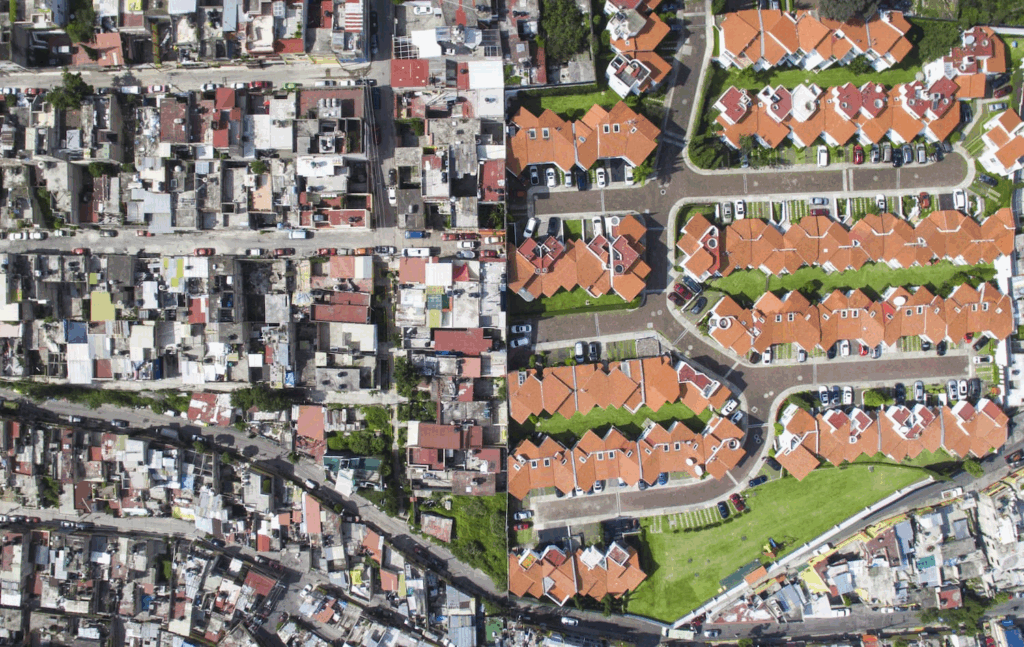
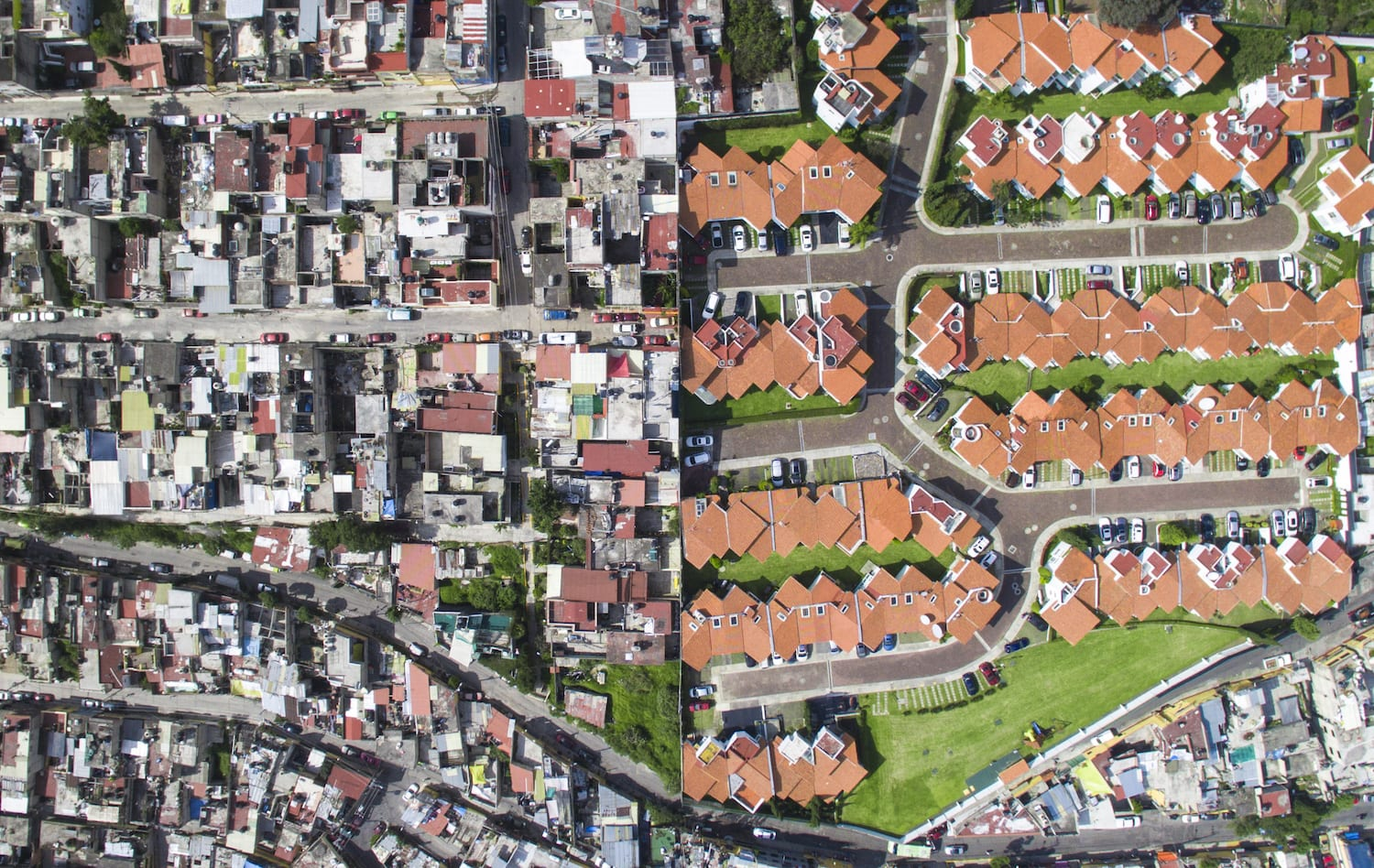

In the last few years, Johnny Miller has emerged as one of the most thought-provoking visual storytellers working across connections of architecture, inequality, and technology. Based in Cape Town, South Africa (and the U.S.), Miller uses drones, photography, and multimedia storytelling to let the world see how the built environment embodies severe social divides, places where wealth and poverty sit unequally, where walls, infrastructure, and planning separate the two.
Miller’s flagship project, Unequal Scenes, captures aerial imagery of urban landscapes juxtaposed with luxury apartments and informal settlements; gated communities overlooking slums; and swimming pools located mere metres away from corrugated-metal shacks. In Miller’s work, the power of perspective is used to render visible the injustice that lies just out of sight. As an architect, his work highlights how planning, architecture, transportation, and services are distributed unequally (and therefore, how we need to be vigilant about it).
But Miller doesn’t only show disparity. He has developed practices and institutions that help change where power and access lie. He co-founded AfricanDRONE, a nonprofit organization that works with African drone pilots to do social good, including mapping, monitoring, documenting stories, and supporting campaigns around urban justice. He is also a Senior Atlantic Fellow for Social and Economic Equity at the London School of Economics, a News Fellow at Code for Africa, and a UN-Habitat Champion.
What makes Miller’s work particularly relevant in design and architecture is the notion he treats space and built form not as boring backdrops, but as real actors in social stories. His stills are not merely documentary; they show how architecture, infrastructure, zoning, and city planning create (or predict) life outcomes around housing. Where is the road paved? Where is it unpaved? Where is there a park, water, sewage, or transport? Where does someone live, what kind of housing do they have, and how far or close are they to opportunities? These questions are critical architectural questions that Miller’s work attributes moral weight to.
His work has been exhibited all over the world, including Photo Art Basel, Unseen, art galleries, and universities. His exhibits don’t only hang in elitist galleries. They provoke discussions about policy, visibility, and rights. Miller believes that by making inequality visible in compelling visual ways, people and government can’t so easily pretend those inequalities are not architectural or spatial.
Why it is particularly important to young people: Miller’s tools are fairly innocuous – drones, phones, cameras, social media – and his visual logic is accessible. He encourages people to see design and architecture not as distant forms of art, but as specific, invested, and everyday expressions of justice. For people interested in climate, housing, city, and equity, Miller offers both a diagnosis and encouragement. He suggests: look at what’s around you, document it, raise it up, perhaps change it.
Looking forward, Miller’s work points to something bigger: architecture and design that not only build flashy buildings, but also make sense of the spaces in between: access, mobility, service, equity, and justice. As the world gets more urban and more unequal, the aerial view can help us figure out what’s at the street level: better planning, inclusive infrastructure, and design that doesn’t only serve the already rich.