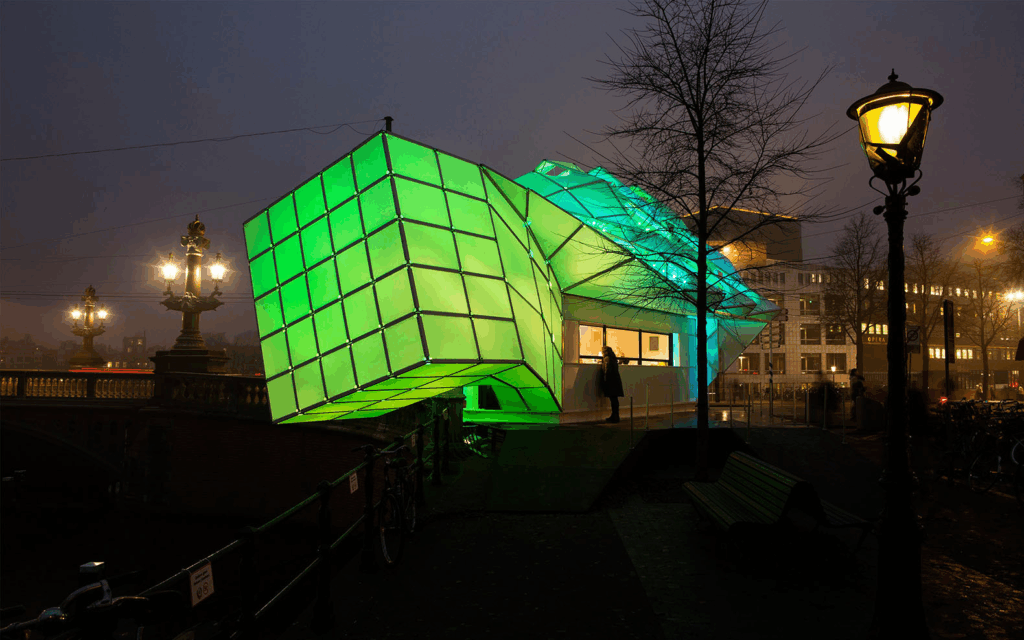
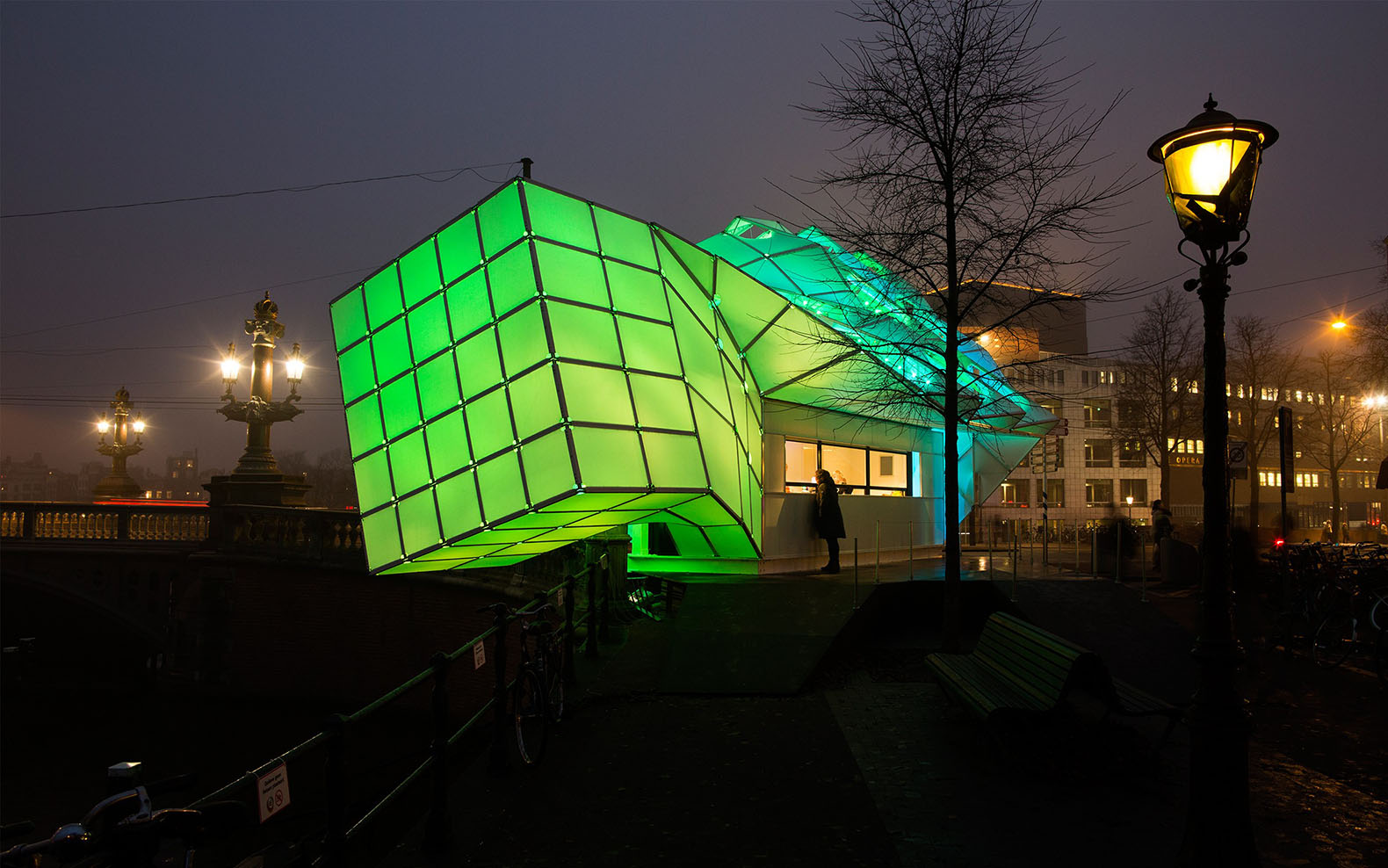

What if our cities lit up like coral reefs? Imagine walking along a riverfront path or city square not under pulsing street lamps, but in a gentle, organic glow that sparkles like starlight. Instead of light bulbs powered by fossil fuels, these lights would come from living organisms – small living things making their own light in the same way that fireflies and deep-sea creatures have done for millions of years. This is the radical potential of bioluminescent architecture.
From Ocean Bottoms to Urban Pavements
Bioluminescence is not a new phenomenon. Nature has perfected its use in countless species, from the anglerfish lures to mushrooms glowing in tropical forests. What is new is humanity’s chance to implement bioluminescence into our everyday habitat. Scientists and architects are asking whether we can use the natural glow of living organisms as a replacement for some of the energy-hungry lighting systems that our cities depend on.
In France, the company Glowee has already developed a prototype streetlight powered by bioluminescent bacteria. These lamps do not pull power from the grid, but instead rely on living systems that produce light when provided with nutrients. In the Netherlands, research laboratories are experimenting with embedding marine bioluminescent microbes into clear panels, creating surfaces that glow like organic neon signs. Even MIT has explored bioluminescent plants and produced glowing greenery that one day could glow as a self-sustaining desk lamp.
Reimagining What Light Is
For designers, the real excitement is not in producing a lot of consumption but in thinking boldly about what light can be as part of the built ecosystem. If it is light from living systems, then it is something we grow and harvest, rather than flip on with a switch. A park that glows brighter after it rains, feeding off he wetness to nourish light-producing cells, in ways previously unthinkable. The exterior of a building that radiates brighter pulses, at night, like its living rhythm blends into that of the city.
This opens up all sorts of aesthetics. Subway tunnels that shimmer like those seen in the inner world of jellyfish. Pavilions of glowing algae flowing through glass tubes, exhibiting patterns of liquid lights. In a school gym where the lights get brighter when students are exercising, the health of the students and the health of the environment are interconnected.
The Challenges of a Living Light
Of course, designs utilizing bioluminescence have potential challenges: how do we “feed” these systems where the light originates from? What if the organisms in a city become sick or are not thriving in winter? Can we expect people to be comfortable knowing that we are walking on streets that are glowing due to bacteria? The more practical discussions about maintenance, scalability, and public acceptability will shape how and if these visions become more than a rare experiment.
And yet, these challenges are not so distant from the larger questions facing the future of sustainable design: how do we come to terms with living systems in urban contexts with respect to human dimensions and ecological limits? By leaving behind the idea that green roofs were once considered visionary but unreliable towards common practice, maybe bioluminescent lighting will transform from a novelty into a necessity.
Why It Matters
Lighting represents nearly a fifth of global electricity use (UBC Sustainability, n.d.). In many urban contexts, streetlights by themselves often take up a significant portion of that energy. Imagine how much energy savings we could have — for our cities and for the planet — if even a part of that were replaced with bioluminescence. However, beyond energy efficiency, bioluminescent architecture represents something deeper: a shift towards a future where human design works in harmony with the processes of nature rather than being in opposition to them.
The hope is not just a glowing street. It is a glowing city, alive with light generated through biology, rather than combustion. Where the lumens are soft, sustainable, and engaged in the natural rhythms of life.
So here’s the compelling question: Do you want your world lit by halogen glare? Or a soft, spectral light of living organisms?