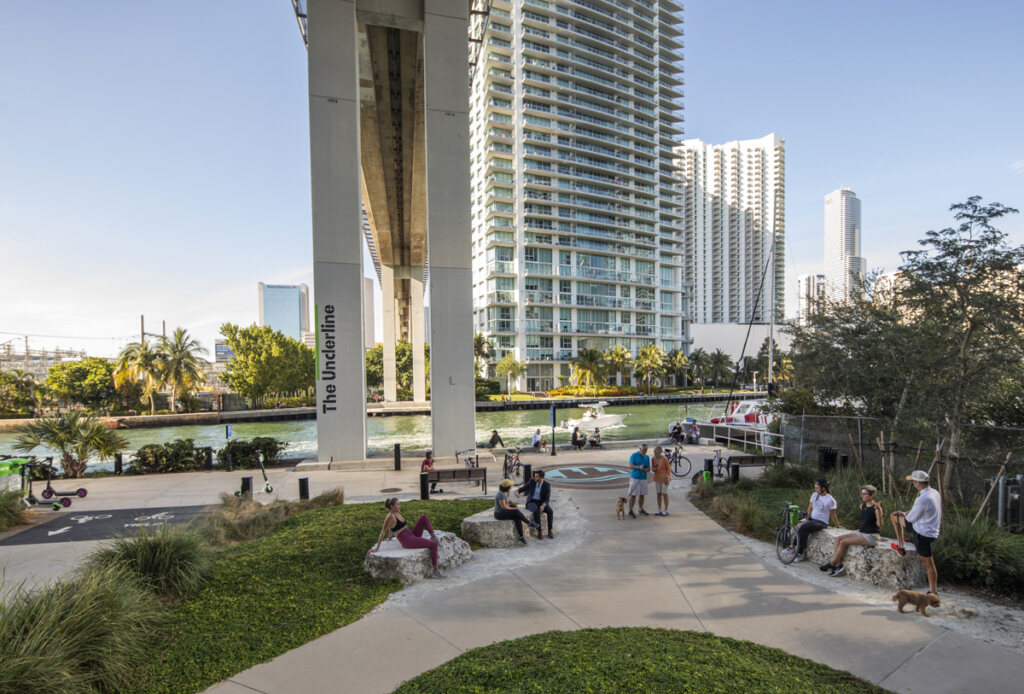

In Miami, nestled under the elevated Metrorail, a different kind of urban space is coming to life. Dubbed The Underline, the project will transform 10 miles of concrete right-of-way into a linear park, cultural corridor, and mobility spine. Where there once was only forgotten space of asphalt, Miami is knitting trails, plazas, art, and native landscapes into a public realm that stretches from the Miami River to Dadeland South.
The Underline project is implemented by non-profit Friends of The Underline and is designed by James Corner Field Operations, the same people who designed New York’s High Line. The ambition of The Underline is to reimagine the way that cities can reclaim surplus infrastructure. Parks are often conceived as elevated parks or green roofs. Still, The Underline embraces its foundation level space to utilize the shelter of the Metrorail to create a shady and connected pedestrian and cycling route that pulls together neighborhoods that were once separated by transit infrastructure.
But the Underline is more than a park; it is intended to be a social backbone for the city of Miami, embedding basketball courts, gardens, outdoor classrooms, and performance stages into the spine of the town. Public art installations reflect Miami’s cultural diversity, while the landscape design results in native ecosystems that are purposefully modeled to respond to surging flood events and build resilience in a city where sea-level rise is a daily threat. The first completed phase of The Underline, “Brickell Backyard,” has already become a social magnet as community members and visitors gravitate toward a space where mobility, ecology, and culture meet.
The importance of The Underline is undermining definitions of what infrastructure could mean. By layering ecology and culture onto the bones of transit, Miami is showing cities a method for repurposing existing infrastructure and frameworks to create community, environmental sustainability, and design innovation. Where there were once only forgotten fractional parcels of land, we now have the seeds of a green artery that runs through one of America’s fastest-growing urban environments.
As future phases are completed over the next three years, The Underline could be the prototype for cities everywhere – establishing that the future of urbanism may not simply be in new construction, but rather in contemplating how to transform the remnant resources we currently have around us.