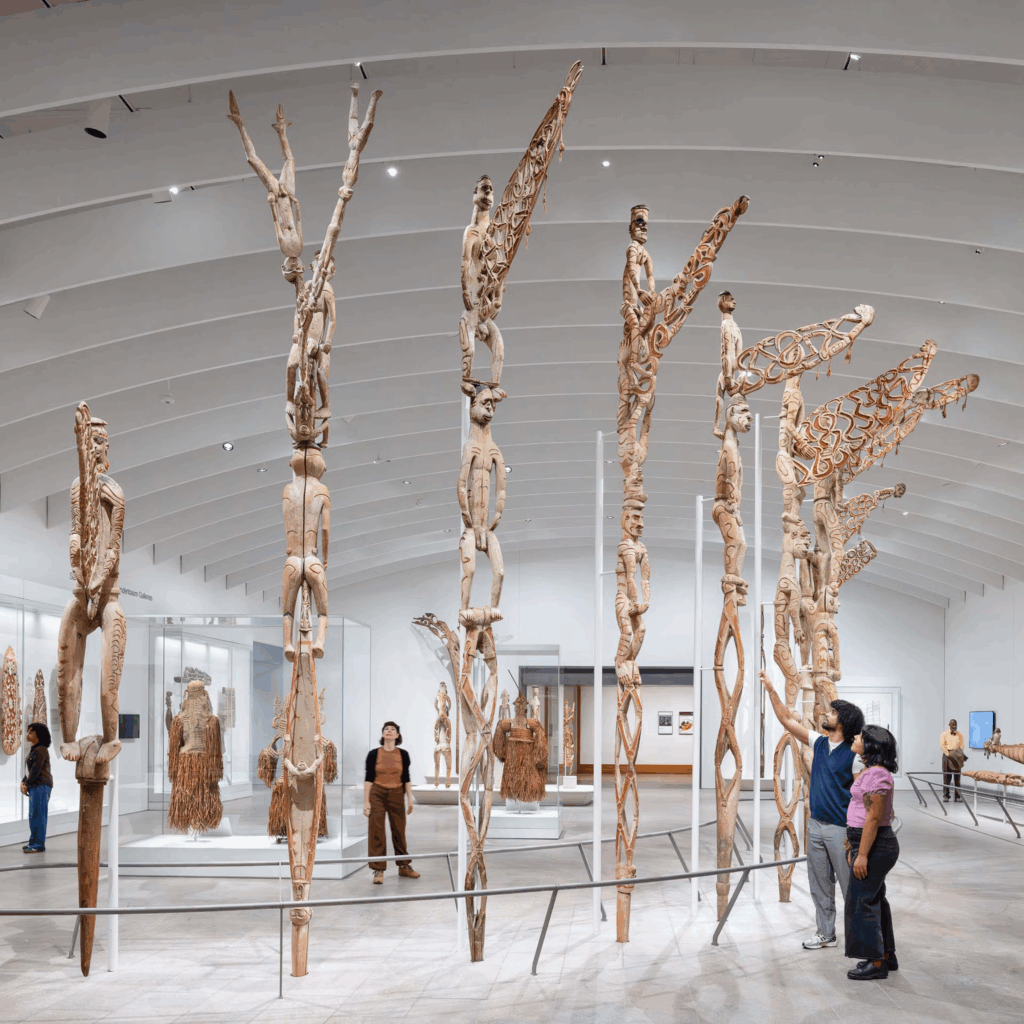
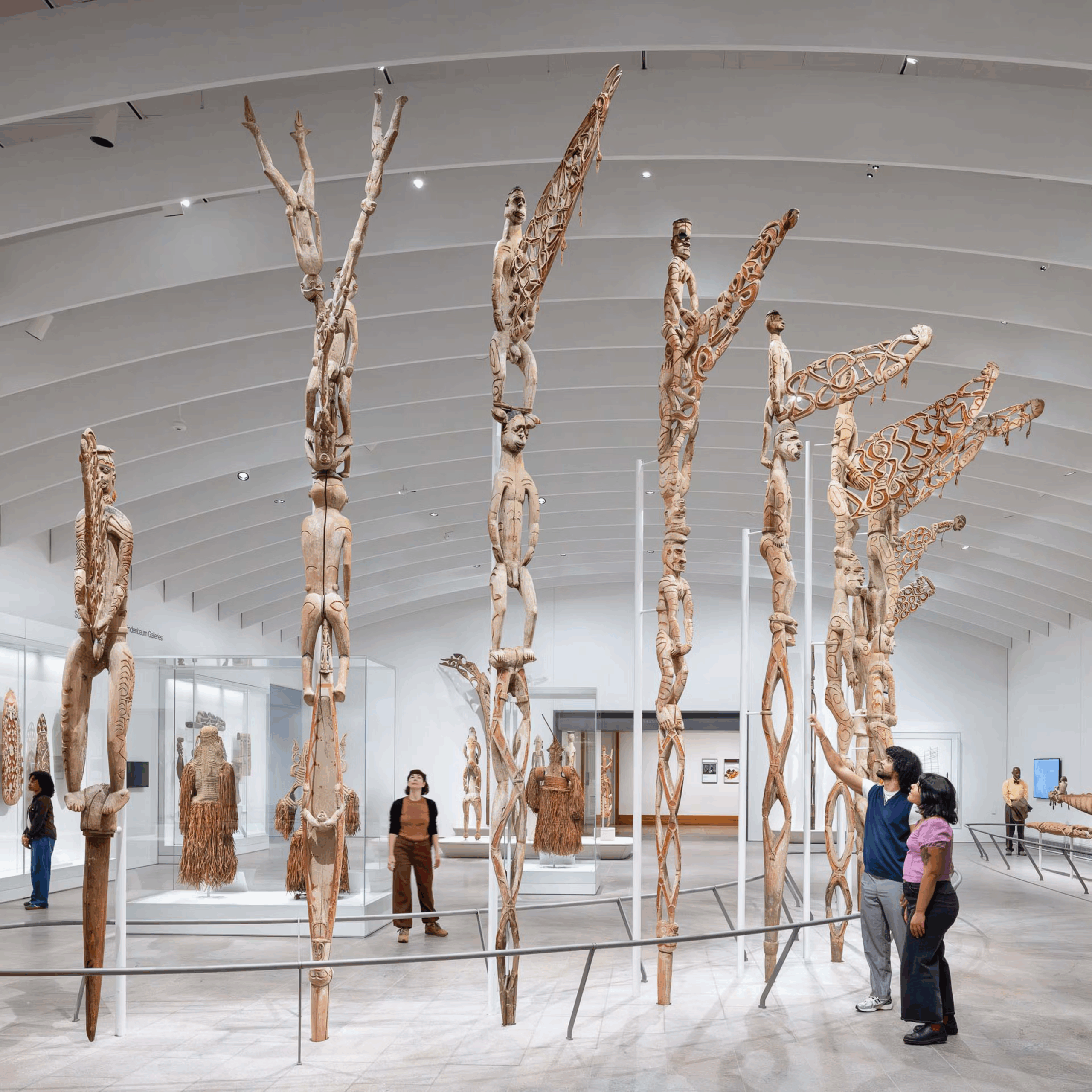

In late May 2025, New York City’s Metropolitan Museum of Art unveiled a dramatic transformation of their Michael C. Rockefeller Wing, containing the Arts of Africa, Ancient Americas, and Oceania. This monumental space, measuring 40,000 square feet, has been under renovation since 2021. The new design is by Kulapat Yantrasast (WHY Architecture), paired with Beyer Blinder Belle architects and The Met’s design department. The refresh yields a bright, inviting gallery with immersive spaces that honor the cultural identity of each region while enhancing visitor engagement and accessibility.
Every design choice in the renovation aims to enhance understanding. The galleries are open, filled with light, spacious, and organized thoughtfully to emphasize the architectural vernaculars of Africa, America, and the Pacific Islands. The ceilings and materials vary slightly across the galleries to create a place, and lighting and multimedia presentations enhance the storytelling around each work of art. The design plan encourages flow and transparency. The integration of public art, expert interviews, and extended interpretive content is designed to engage visitors as they move, reflect, and engage with cultures around the world.
The design challenges our assumptions around aesthetic changes. The project signals The Met’s commitment to equity and cultural empathy. Alisa LaGamma, curator of African Art, states that the redesign “deepens public appreciation” for each of the collections because it emphasizes the artists and histories behind the works. The architect, who worked on the project and has personal connections to cross-cultural practices, reminded us that The Met and similar museums must act as ambassadors for empathy and education. There is a balance between small moments in gallery spaces and generous spaces for public engagement, enhancing both individual and shared experiences in the museum.
The Rockefeller Wing’s significance lies in its potential to connect art and architecture in the service of telling global stories. Equally, the Met suggests, with intention and design considerations, how a museum can provide support for intercultural empathy, diversity, and education through spatial experiences that incorporate sensitivity and thoughtful design towards underrepresented cultural traditions. It is at once an assertion of form and function, a statement that architecture can foster intercultural connection and understanding in the middle of one of the busiest cities in the world.
The newly renovated Rockefeller Wing is anticipated to serve as a model for museum projects in the twenty-first century: institutions that no longer function as a benign audience to art, but as actively engaged hosts, enhancing the immersive nature of shared cultural experiences. It pairs well with the ongoing expansion across the city, starting with the New Museum’s extension and the new Studio Museum in Harlem, which reinforces NYC’s contribution to the cultural infrastructure of experiences for all as a global leader.